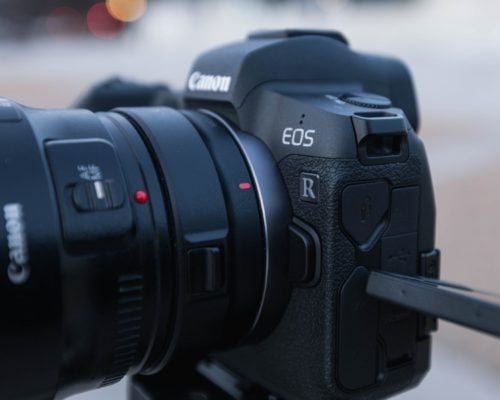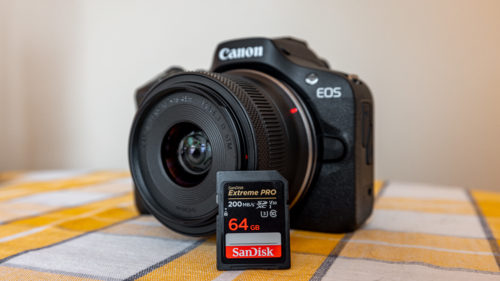

A lens mount is the connection between a lens and a camera body. Canon announced the RF lens mount in 2018 for their new full-frame mirrorless system. The RF mount first shipped on the EOS R and now appears across the lineup, including the R1, R5 Mark II, R5, R6 Mark II, R6, and R8.
In 2022 Canon also introduced RF-S lenses, which are designed for the APS-C (cropped sensor) RF cameras like the R7, R10, R50, and R100. If you mount an RF-S lens on a full-frame RF body, the camera automatically crops to the APS-C area, so you still get a usable image at a smaller resolution.
Canon’s older EF lens mount has been around since 1987. Both the EF and RF mounts share the same 54mm throat diameter, so the size of the opening is identical. The real difference is the flange focal distance (the gap from the lens mount to the sensor): 44mm on EF versus 20mm on RF. That shorter distance is what gives Canon room to design RF lenses with new optical layouts and faster apertures.
Some of the more popular RF lenses include:
- Canon RF 15-35mm f/2.8 (sample photos)
- Canon RF 24-70mm f/2.8
- Canon RF 28–70mm F2
- Canon RF 70-200mm f/2.8
More RF lenses can be seen here.
Can you use RF lenses on EF mounts?
No, RF lenses do not work on EF mount cameras. The bayonet pattern is different, the electronic interfaces don’t match (12-pin RF vs 8-pin EF), and the rear of an RF lens sits too close to the sensor for an EF body’s 44mm flange focal distance. There is no official adapter that goes from RF lens to EF body, and physically forcing one on would damage the lens or camera.
Can you use EF lenses on RF mounts?
EF and EF-S lenses won’t mount directly to an RF body, but you can use them with an adapter. Canon makes three official EF to RF mount adapters: a basic adapter (around $100), a Control Ring version that adds a customizable ring on the adapter, and a Drop-In Filter version that lets you use circular polarizer or variable ND filters between the lens and sensor. I’ve used the basic adapter with all of my EF lenses on my Canon mirrorless bodies and they work as expected, including full autofocus and image stabilization.
Do you lose image quality with an EF to RF adapter?
No. Canon’s official EF to RF adapters are essentially a hollow tube with electronic contacts, so there’s no extra glass between the lens and the sensor. Image quality, autofocus speed, and image stabilization all behave the same as the lens did on an EF body. From my own use of the basic adapter with several EF L-series lenses, I haven’t seen any drop in sharpness or AF performance. The two adapters that do add glass (the Drop-In Filter version and the now-discontinued 0.71x speedbooster for cinema) are intentional optical accessories, not standard adapters.
What are the benefits of RF lenses over EF?
The short version: RF lenses give Canon’s engineers more room to design around. The 20mm flange focal distance and 12-pin electronic interface let RF lenses focus faster, communicate more data with the body, and use new optical formulas that wouldn’t be possible on EF. In practice, that shows up as faster and quieter autofocus, in-lens image stabilization that works in tandem with body IBIS (Coordinated Control IS), shorter minimum focus distances, and unusual aperture/focal-length combinations like the RF 28-70mm f/2 and RF 50mm f/1.2.
What cameras use Canon RF lenses?
Canon’s full-frame RF mount cameras include the EOS R, R5, R5 Mark II, R6, R6 Mark II, R8, Ra, RP, and the flagship R1. The APS-C RF mount cameras (which take both RF and RF-S lenses) include the R7, R10, R50, R50 V, and R100. If a Canon body has an RF mount, it can use any RF lens.
Why did Canon switch from EF to RF?
Canon switched to keep up with the industry shift from DSLR to mirrorless. Mirrorless bodies don’t have a mirror box, which means the rear of the lens can sit much closer to the sensor (20mm on RF versus 44mm on EF). That shorter flange focal distance, combined with the new 12-pin electronic interface, gives Canon room to build lenses that focus faster and use optical formulas the EF mount couldn’t accommodate. Sony moved to mirrorless with the E-mount in 2010 and Nikon launched the Z-mount in 2018, so RF was Canon catching up to where the rest of the industry was already heading.
What is the difference between Canon RF lenses and EF lenses?
The main difference is the mount and the camera system each one fits. RF lenses are built for Canon’s mirrorless cameras, while EF lenses were built for Canon’s DSLR bodies. Both mounts have the same 54mm throat, but RF lenses use a much shorter 20mm flange focal distance and a 12-pin electronic interface (EF uses 8 pins). The shorter distance and faster data link give RF lenses faster autofocus and let optical designers push wider apertures and shorter minimum focus distances. Canon stopped releasing new EF lenses years ago, so the RF lineup is where all the new optics are landing.
What types of Canon RF lenses are available?
Canon offers RF lenses across all the usual focal length categories: wide-angle, standard, and telephoto zooms, plus a wide range of primes. The lineup splits into pro-grade L-series lenses (red ring, weather-sealed) and more affordable non-L options. Common picks include the RF 24-70mm f/2.8L IS USM for events and weddings, the RF 50mm f/1.2L USM for portraits, and the RF 70-200mm f/2.8L IS USM for sports and telephoto work.
Are Canon RF lenses compatible with third-party camera brands?
Canon-made RF lenses only fit Canon RF mount cameras. The mount itself was closed to third parties for years, but Sigma, Tamron, and Samyang have started releasing RF mount lenses recently, so you’ll see more options beyond Canon’s own lineup over time.
Do Canon RF lenses have image stabilization?
Many do, but not all. RF lenses with optical image stabilization have “IS” in the model name (for example, the RF 24-70mm f/2.8L IS USM). Lenses without IS rely on the camera body’s in-body image stabilization (IBIS), which most modern Canon mirrorless bodies have. On bodies that combine both, Canon calls it Coordinated Control IS and you get the most stabilization.
Are Canon RF lenses weather-sealed?
Most L-series RF lenses are weather sealed (the red ring marks the L lineup). The non-L RF lenses are typically not weather sealed, so if you shoot in rain, snow, or salty coastal air, stick with L-series glass.
Are Canon RF lenses more expensive than EF lenses?
Comparable lenses tend to cost more on the RF side than the EF side. Part of that is age (RF is the current lineup; EF is mostly off the shelves except as used gear), and part of it is that Canon launched RF with a lot of premium L-series glass first. There are still affordable RF options like the RF 50mm f/1.8 STM, RF 16mm f/2.8 STM, and the RF-S kit zooms.
Is Canon discontinuing EF lenses?
Canon hasn’t released a new EF lens since 2018 and the lineup has been quietly shrinking each year, but they haven’t formally killed the line. Many EF lenses are still sold new and Canon still services them through their repair program. If you already shoot EF, your gear is fine to keep using on EF bodies or on an RF body with an adapter. If you’re buying into Canon today, RF is where all the new development is happening.
Do Canon RF lenses come with a warranty?
New Canon RF lenses come with Canon’s one-year limited warranty in the U.S. Coverage and length vary by region, so check Canon’s site for your country before relying on it.
Which Canon RF lens should I buy first?
It depends on the body and what you shoot. For a full-frame body like the R8 or RP, the RF 50mm f/1.8 STM is the cheapest way to get a fast prime, and the RF 24-105mm f/4-7.1 IS STM kit zoom is the most flexible everyday lens. For an APS-C body like the R10 or R50, the RF-S 18-150mm IS STM is the most versatile single lens for travel and general use. If you mostly shoot portraits, the RF 50mm f/1.8 STM works well on either format.
Conclusion
That covers the basics of the Canon RF system. If you’re shopping for your first RF body or lens and have a question I didn’t answer here, leave it in the comments and I’ll do my best to help.