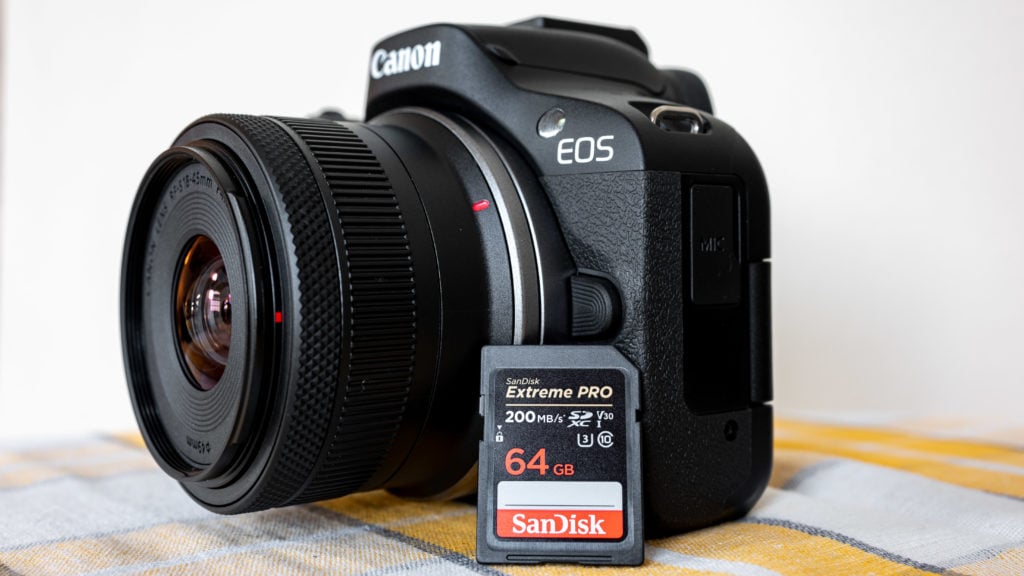
Looking for an SD card for the Canon R50? In this post I’ll cover the best memory cards for the Canon EOS R50. The R50 is a UHS-I camera with a single SD slot, so a quality U3 (V30) UHS-I card is all you need. A more expensive UHS-II card won’t make the camera any faster.
Shop for a Canon EOS R50 on B&H Photo
Quick context on the R50: 24.2MP APS-C sensor, DIGIC X processor, full-width UHD 4K up to 30p (no crop), 1080p up to 120p slow motion, and 15 fps mechanical burst. The most demanding modes for the SD card are 4K 30p and high-speed continuous shooting, both of which want a U3 / V30 rated card.
Canon EOS R50 Memory Card Recommendations
The Canon R50 has a single SD card slot that supports SD/SDHC/SDXC memory cards with a UHS-I.
- Memory Card Slots: 1 (Eye-Fi and Multimedia cards are not supported)
- Memory Card Type: SD/SDHC/SDXC Card
- Memory Card Speed: UHS-I
Since the Canon R50 only supports UHS-I bus speeds, you don’t need a UHS-II card to get full performance from the camera. A faster UHS-II card will work fine but it’ll just sit at UHS-I speeds. If you’re buying a new card specifically for the R50, save the money and stick with a quality UHS-I card.
Best UHS-I SD memory cards for Canon EOS R50
I typically trust SanDisk for affordable SD cards and the Extreme Pro makes a great choice for the Canon EOS R50. Since UHS-I memory cards are so affordable you can get a larger storage card for a great price so you have plenty of storage.
My Pick: SanDisk 128GB Extreme PRO SDXC UHS-I
The SanDisk Extreme Pro UHS-I hits 200 MB/s read and 140 MB/s write, which is far more than the R50’s UHS-I interface needs. It is V30 rated, so it handles 4K 30p and 15 fps burst RAW shooting without choking the buffer. 128GB is the sweet spot for most R50 owners.
Budget pick: SanDisk Extreme UHS-I
If price is the priority, the regular SanDisk Extreme UHS-I (the non-Pro version) is a step down in speed but still U3 / V30, which is all the R50 actually requires. Read/write is around 190 MB/s / 90 MB/s. Plenty for 4K 30p and stills.
High-capacity pick: SanDisk Extreme Pro 256GB+
For heavier video shooters or long trips, jump to 256GB or 512GB SanDisk Extreme Pro UHS-I. The price-per-gigabyte gets better at higher capacities and you spend less time swapping cards in the field. The R50 supports SDXC up to 2TB in theory, but 256GB to 1TB covers nearly every real-world use case.
Canon EOS R50 SD Card Specifications
Canon publishes the official SD card requirements in the R50 manual, broken down by video mode. The image below is the relevant table. The short version: any quality UHS-I U3 (V30) card handles every video mode on the camera.

How to Format SD Cards on Canon EOS R50
Formatting memory cards on the Canon EOS R50 is a simple process. To format a memory card, access the camera’s menu by pressing the Menu button. Navigate to the “Setup 1” section (indicated with a wrench icon) and look for the “Format card” option. Select it, and you will be prompted to format the memory card.
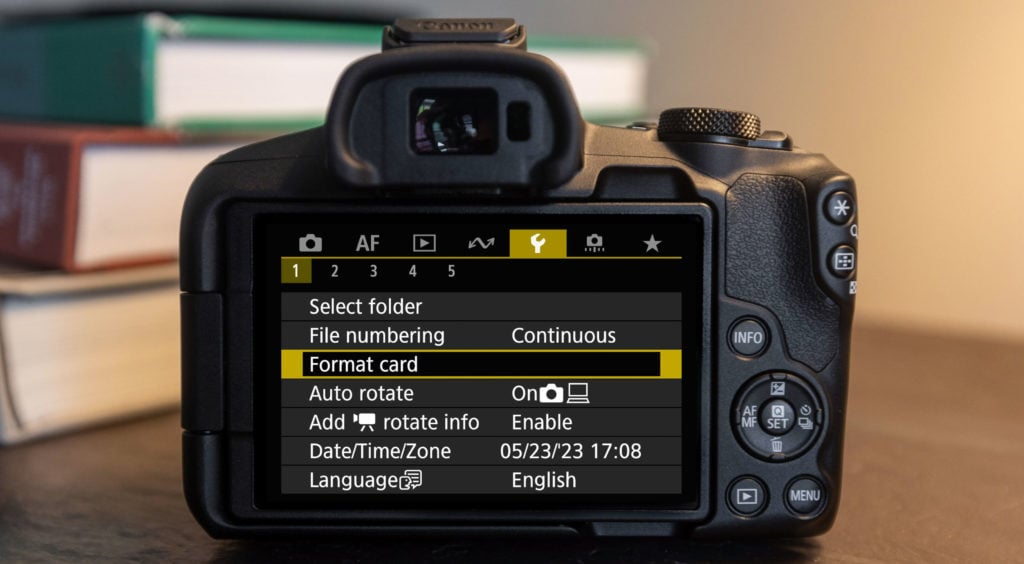
Within the formatting options, you may also have the choice to perform a low-level format, which completely erases all data on the card, including sensitive photos that you want to ensure cannot be recovered.
To ensure optimal performance with your Canon EOS R50, it is recommended to format your new memory card once you have it.
If you’re upgrading from a DSLR, the SD card you already own probably works fine in the R50 (UHS-I U3 cards have been the standard for years). The most demanding things you can do for the card are 4K 30p video and high-speed continuous burst shooting, so those are the modes to confirm work smoothly with whatever card you use.
Canon R50 SD Card FAQ
What memory card type does the Canon R50 use?
The Canon EOS R50 uses standard SD memory cards (SD, SDHC, and SDXC formats), and only supports UHS-I bus speeds. There is a single SD card slot. Eye-Fi and Multimedia cards are not supported.
Does the Canon R50 come with a memory card?
No. Canon ships the EOS R50 body-only or as a kit with the RF-S 18-45mm lens, but no SD card is included in either box. Plan to buy one separately.
Does the Canon R50 need a UHS-II SD card?
No. The R50 only supports UHS-I bus speeds. A UHS-II card will physically fit and work, but it will run at UHS-I speeds. There’s no performance benefit, so save the money and pick a quality UHS-I U3 (V30) card instead.
What is the maximum SD card size for the Canon R50?
The R50 supports SD, SDHC, and SDXC formats. SDXC is rated up to 2TB in theory. In practice, 256GB to 1TB SDXC cards are widely tested with the R50 and work without issues.
What speed class does the Canon R50 need for 4K video?
Canon’s official requirement for 4K 30p on the R50 is at least UHS Speed Class 3 (U3). Most cards branded “Extreme” or “Extreme Pro” exceed this. Slower Class 10 cards may work for stills only but will throttle 4K recording.
What size SD card should I get for the Canon R50?
128GB is the sweet spot for most R50 owners. It is large enough for a long trip’s worth of RAW photos plus 4K video, and the price is reasonable. If you shoot a lot of 4K or travel for weeks at a time, 256GB or 512GB makes sense.
For more on the R50, see my Canon R50 setup guide, which covers the menu settings worth changing.