Canon regularly releases firmware updates that fix bugs, improve autofocus performance, and sometimes add entirely new features to your camera. Updating only takes a few minutes and is one of the easiest ways to get more out of your gear.
Here’s my step-by-step guide on how to update the firmware on your Canon camera. This process works for all Canon EOS R mirrorless cameras (R5, R6, R7, R8, R10, R50, R100, and others) as well as Canon DSLRs.
Table of contents
How to Check Your Current Firmware Version
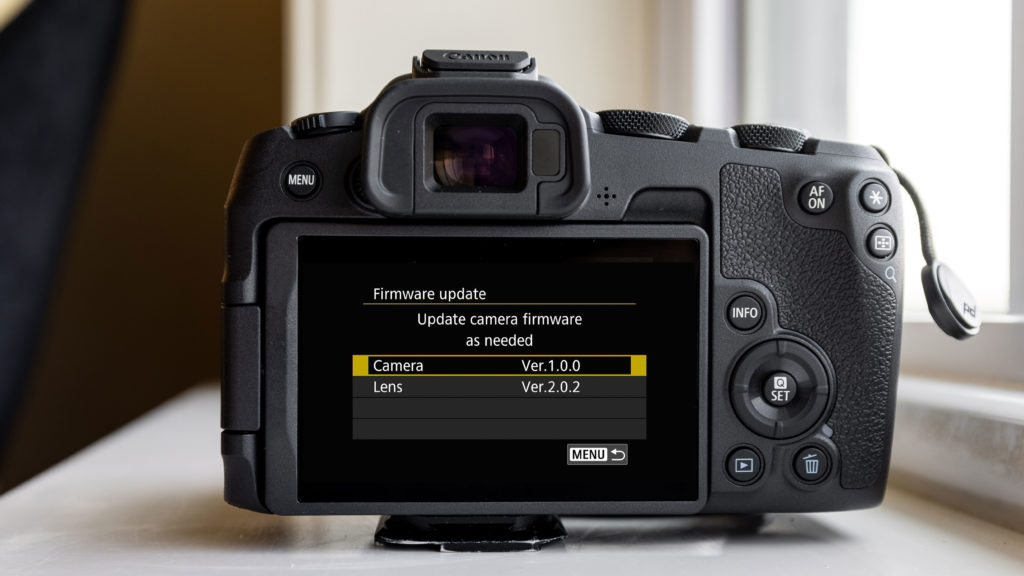
Before downloading anything, check which firmware version your camera is running. On most Canon cameras, go to Menu > Settings (wrench icon) > Firmware ver. and your current version number will be displayed. Compare this to the latest version available on Canon’s website. If they match, you’re already up to date.
If your camera is behind, follow the steps below to download and install the latest firmware.
Getting Started
The process to download a firmware file I will admit is a bit cumbersome. I am hoping they improve this in the future but here’s the step by step guide to downloading a firmware file from Canon.
Download the Firmware
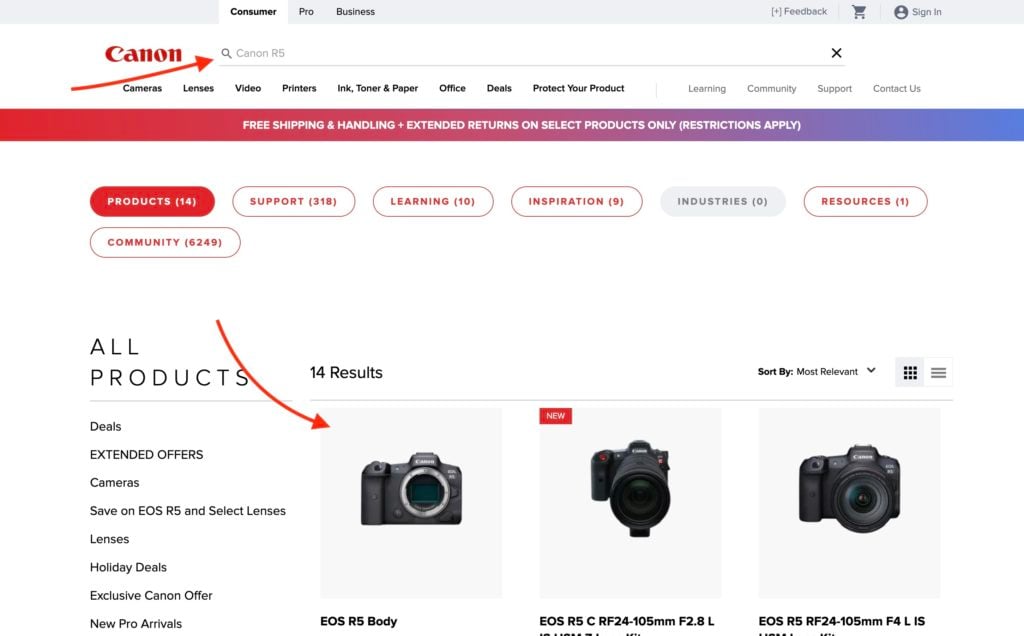
Start by visiting the main Canon site and searching for your camera using the search bar.
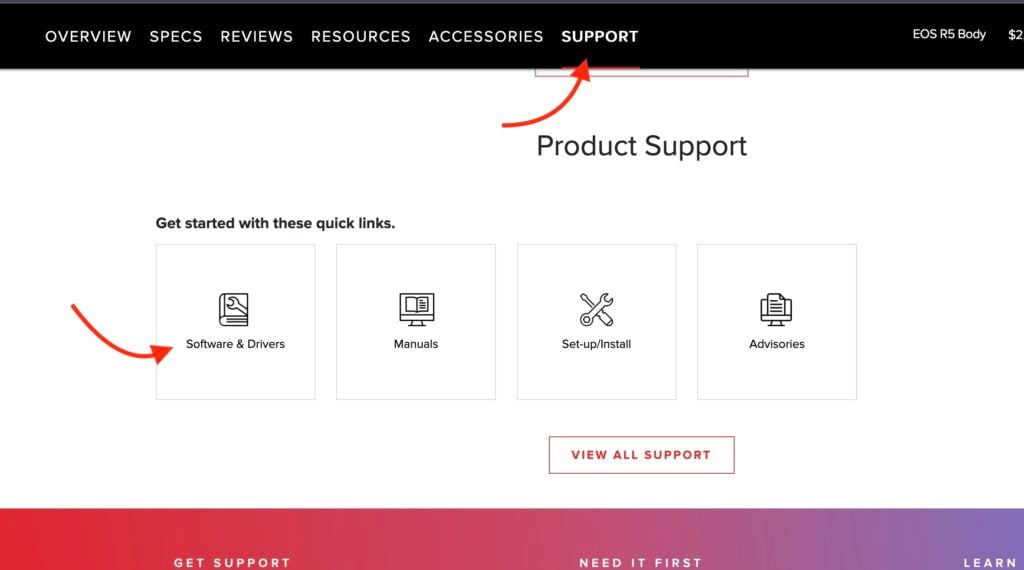
Then once you’re on a camera’s page you can click the support button which will take you to the download section for the camera.
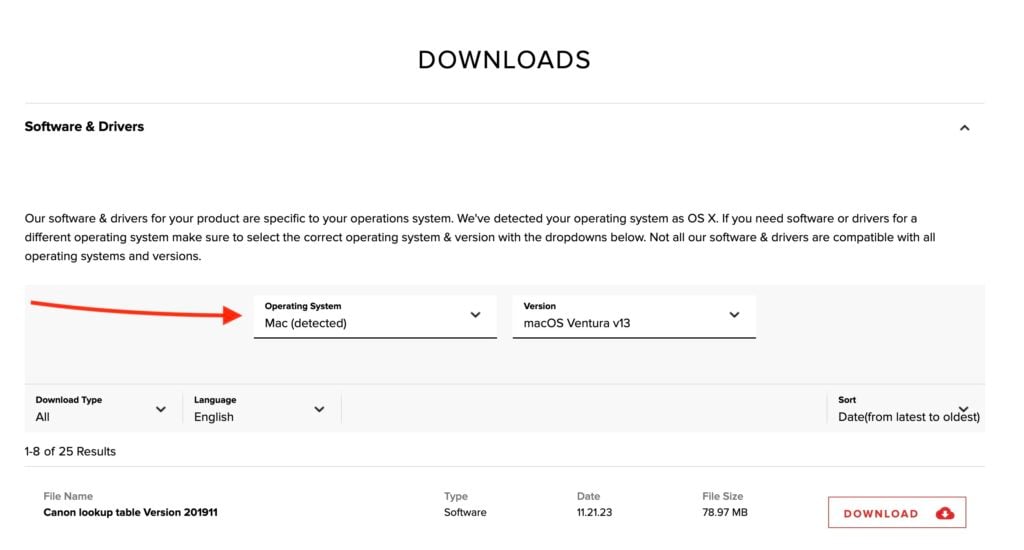
Once you are on the specific camera’s support page you can head do downloads and select your OS/OS version. The .FIR files for Canon cameras are universal so I find it really odd you have to do this. But if you select the latest MacOS for example the firmware won’t show up for whatever reason. So if you don’t see the firmware update try selecting a lower version of your OS. (For example I am on MacOS 14 but selecting MacOS 13).
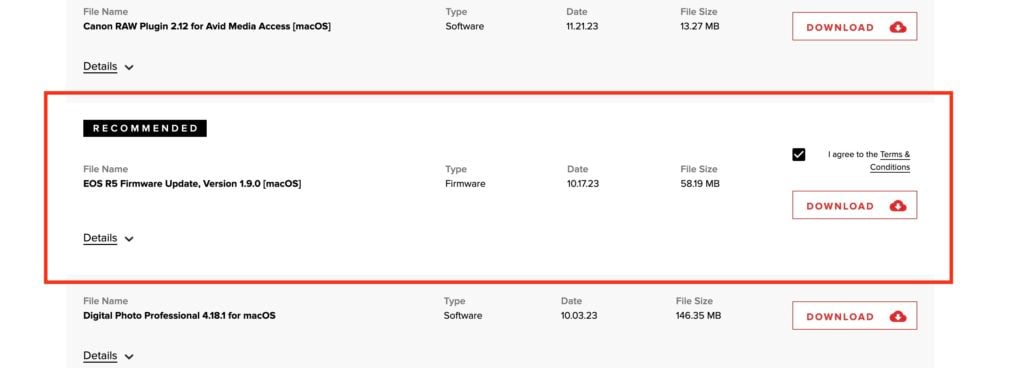
You can scroll the file list to fine your camera’s firmware update as seen below. Remember to save the file in a location that is easily accessible. The package usually contains a .FIR file, which is the firmware update, along with detailed installation instructions in English.
Charge Your Camera Battery
Before you begin the firmware update, ensure that your camera battery is fully charged. This precaution avoids the risk of disrupting the update process.
Format a Memory Card
If you are going to update the firmware using a memory card (which I recommend), it’s essential to format the memory card for use in the camera. Remember to back up any images you want to keep from the card before formatting it. You can format your card on your camera or on your computer (here’s my guide to formatting SD cards on Mac.) Always format the card in the camera that will undergo the firmware update.
Ways to Update
Method 1: Update via Memory Card (Recommended)
This is the most reliable method and the one I always use.
- Copy the .FIR firmware file to the root directory of your formatted memory card (not inside any folder).
- Insert the card into your camera and turn it on.
- Go to Menu > Settings (wrench icon) > Firmware ver.
- The camera will detect the firmware file and ask if you want to update. Select OK.
- Wait for the update to finish. The camera will restart automatically when done. Do not turn off the camera or remove the battery during this process.
Method 2: Update via EOS Utility Software
If you prefer using a computer connection:
- Install Canon’s EOS Utility software on your computer (available from Canon’s support site).
- Connect your camera to the computer with a USB cable and turn the camera on.
- Open EOS Utility. It should detect your camera automatically.
- If a firmware update is available, the software will prompt you to install it. Follow the on-screen instructions.
Method 3: Update via Canon Camera Connect App
Newer Canon cameras (most EOS R series models) support firmware updates through the Canon Camera Connect app on your phone. Connect your camera to the app via Bluetooth or Wi-Fi, and the app will notify you when a firmware update is available. You can install it directly from your phone without needing a computer or memory card. This is the easiest method, though it requires a stable connection throughout the update.
Troubleshooting
- Camera doesn’t detect the firmware file: Make sure the .FIR file is in the root of the memory card, not inside a folder. Also confirm you formatted the card in the camera, not on your computer.
- Firmware doesn’t show up on Canon’s website: Try selecting an older OS version in the download filter. The .FIR files are universal across Mac and Windows, but Canon’s site sometimes hides them under older OS versions.
- Update stalls or camera freezes: Do not remove the battery. Wait at least 10 minutes. If the camera is still unresponsive, remove and reinsert the battery, then try the update again with a freshly formatted card.
- “Firmware version is already current” message: Your camera is already running the latest version. No action needed.
Recent Canon Firmware Updates (2025-2026)
Canon has been active with firmware updates across its EOS R lineup. Here are some notable recent updates:
- EOS R6 Mark III, R5 Mark II, R5: Stability fixes, expanded accessory support, and reliability improvements for demanding shoots.
- EOS R7 (v1.8.0): Bug fixes including Err70 issues, improved display settings for the RF-S 7.8mm dual lens, and new 3:2 and 1:1 aspect ratio options.
- EOS R5, R6 Mark II (2025): Added racing car and motorcycle detection for autofocus tracking, exposure simulation for flash shooting, and network security PIN codes for European cybersecurity compliance.
- EOS R8, R10, R50: Network security enhancements and general stability improvements.
- EOS R1, R5 Mark II: Support for 8TB CFexpress cards added.
You can always find the latest firmware releases on Canon’s professional firmware updates page or by searching for your specific camera model on the Canon support site.
Frequently Asked Questions
Should I update my Canon camera firmware?
Yes. Firmware updates often fix autofocus issues, improve image processing, add new video modes, and patch security issues. There’s no downside to staying current, and some updates add features that would otherwise require buying a new camera.
Can a firmware update damage my camera?
Firmware updates from Canon are safe. The only risk is interrupting the update (removing the battery, power loss), which is why a full battery charge is required before starting. If an update does get interrupted, you can usually recover by trying the update again.
How often does Canon release firmware updates?
It varies by camera model. Popular models like the Canon R8 and R5 tend to get updates every few months after launch, then less frequently as they mature. Canon doesn’t follow a fixed schedule, so check the support page for your specific camera periodically.
Can I update Canon lens firmware too?
Yes. Canon RF lenses also receive firmware updates. You can update lens firmware through the camera’s menu (with the lens attached) or through EOS Utility. The process is the same: download the .FIR file from Canon’s site and load it via memory card or USB.
Wrapping Up
Firmware updates are one of the simplest ways to keep your Canon camera performing at its best. The memory card method takes about 5 minutes from start to finish, and the Canon Camera Connect app makes it even easier on newer models. I recommend checking for updates every couple of months, especially after Canon announces new features for your camera. A quick visit to Canon’s support page is all it takes to stay current. While you’re at it, it’s worth checking your Canon shutter count every so often, since it gives you a rough idea of how much life your camera has left.
Once your firmware is up to date, make sure you also have the right memory card to match your camera’s capabilities. Check out my guides to the best memory cards for the Canon R8, R7, and R50.