
Whether it’s Independence day or New Years there are plenty of opportunities to capture fireworks throughout the year. In this article I’ll go over firework photography tips including the best settings for fireworks photos and what gear you’ll need. This guide is made for beginners and pros alike so no matter your skill level I’m hoping you learn something.
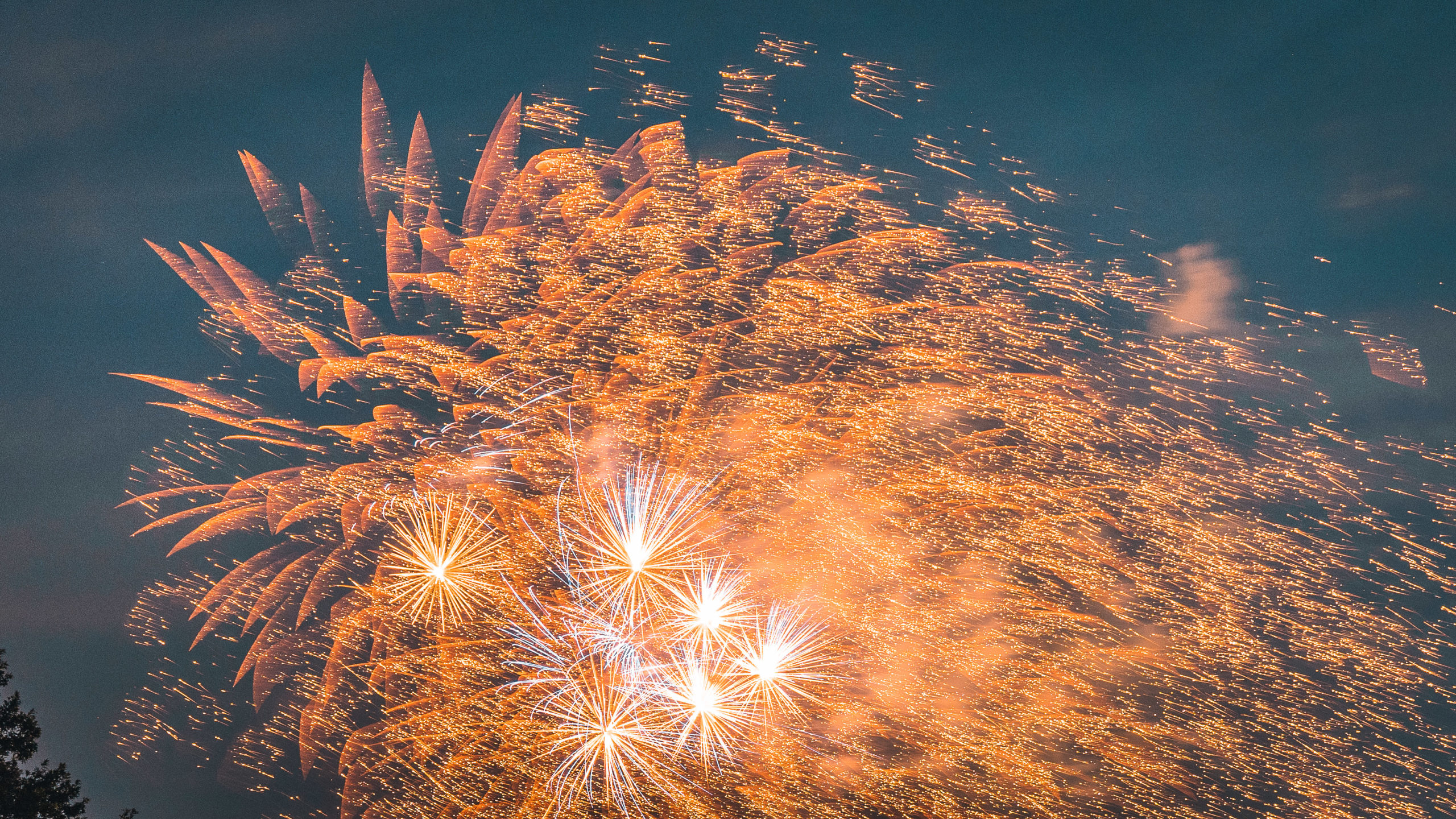
Typically firework shows can last 15 to 30 minutes so being prepared before hand will help you get the best shots. You’ll have very little time to fiddle with settings and gear.
Table of Contents
Camera Settings for Fireworks
Now let’s get into the details of what camera settings to use for fireworks. Of course you’ll want to use a DSLR or mirrorless camera so you can control all of the settings.
Here’s a quick breakdown of camera settings for fireworks:
- Use a tripod
- Mode: Manual
- Image Format: Shoot RAW
- ISO: 100-400
- Aperture: f/8 to f/13 (a lower f-stop gives brighter, thicker trails; a higher f-stop gives finer trails and richer color)
- Shutter Speed: Bulb or 3-5 seconds (open the shutter right before the explosion)
- Turn off Noise Reduction
- Disable lens and sensor stabilization
- Manually focus on something at the same distance of the fireworks before they launch
- White Balance: Daylight (about 5500K) so the colors stay true instead of shifting on Auto
You’ll want to shoot using manual exposure and manual focus. This will ensure your camera settings don’t change when the firework shot starts. Manual focus is needed since autofocus will cause your camera to hunt for focus during the firework show.
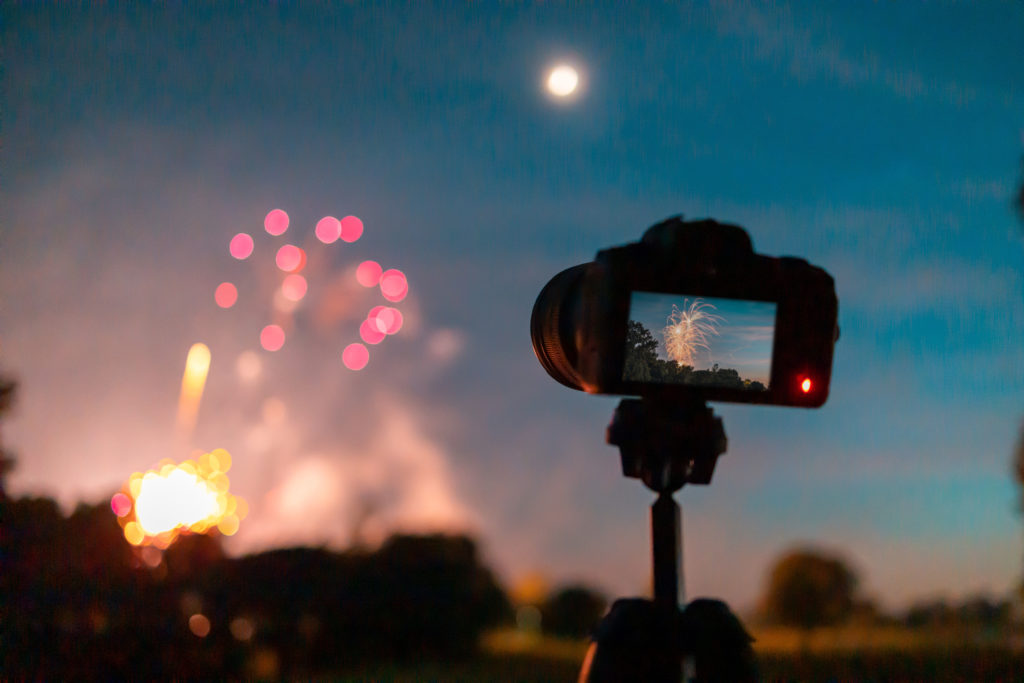
Now let’s go into detail of each setting for getting the best photos of fireworks.
Generally you’ll want to shoot RAW instead of JPEG which will allow you more editing flexibility in shadows and white balance.
Shooting in manual with a low ISO like ISO 100-200 will ensure your photos have little grain.
Experiment with different apertures but f/8-f/13 will give you darker richer colors while lower f-stops like f/2.8 will give you a brighter image. Just keep in mind your aperture will affect your shutter speed.
You’ll likely want to shoot with a shutter release and bulb, holding the shutter open when the firework goes off. Alternatively a 3-5 second exposure time will do the trick, just quickly note if your exposure too bright or dark while shooting to adjust on the fly.
There are also a few minor camera settings you’ll want to adjust. You’ll want to turn off your camera’s noise reduction since this process slows down shooting. Additionally turning off lens and sensor stabilization will ensure your camera doesn’t move during tripod shooting. You’ll likely want your lens to be in manual focus mode so you aren’t focus hunting during shooting. This can be done by focusing on something in the distance before they launch or focusing on the first firework then turning manual focus on.
And then you’ll just have to wait for the dark sky and for the show to start!
Keep reading for specific firework photography tips & tricks.
What to Bring
Fireworks shows are short and it’s dark out, so pack everything ahead of time. Here’s a quick checklist:
- A sturdy tripod (the single most important piece of gear)
- A remote shutter release or intervalometer, or use your camera’s app or 2-second timer
- A wide lens and a telephoto, so you can change your framing without missing the show
- Spare batteries and memory cards
- A small flashlight or headlamp (a red light keeps your night vision)
- A microfiber cloth to wipe humidity or smoke off the front of your lens
- A black card or hat if you want to try stacking bursts (more on that below)
Firework Photography Tips
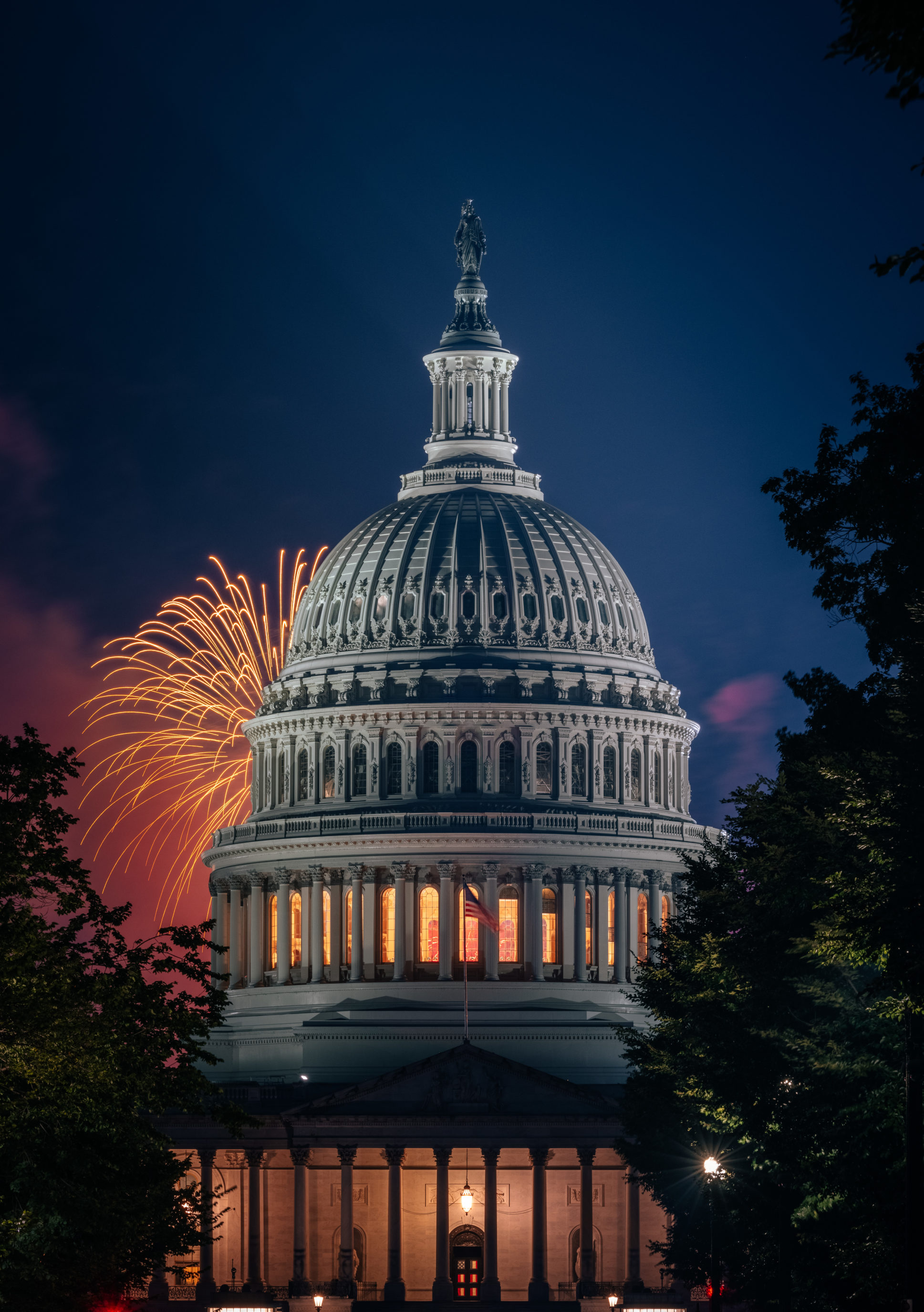
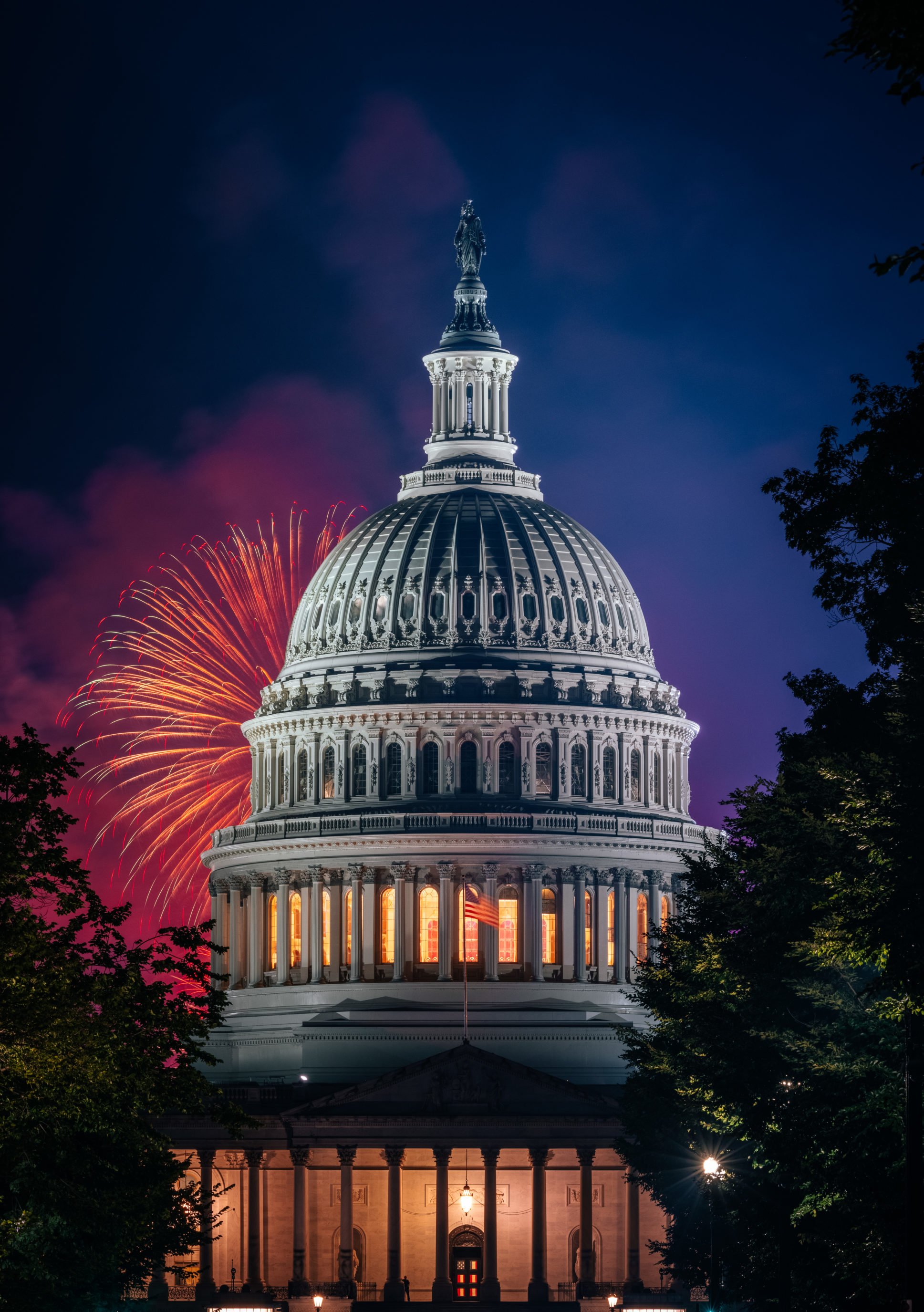
Here are my top tips for getting great fireworks photos:
1. Use a Tripod
To get the sharpest and cleanest shots you’ll need to use a tripod to reduce camera shake. This is extremely important because you’ll be doing 2+ second long exposures to capture all of the details of the fireworks. By dragging the shutter in photos the effect of the fireworks is pronounced.
2. Reduce Shaking by using a Remote Release
Every time you hit the shutter button there is a small amount of shaking that occurs. This is why using a 2-second delay or shutter release is essential. I found it really hard to time capturing the fireworks going off with a 2-second delay so I recommend a remote.
Most camera brands make remote shutter buttons for their cameras that allow you to simply plug them in and hit a button to trigger the shutter. This will make it easy to perfectly time your shutter opening when the firework explosion goes off. Alternatively most newer cameras will let you trigger the shutter using an app. Just make sure your phone is connected and ready to go before the firework shot.
Using bulb mode in your camera will allow you to hold the shutter for as long as a firework is exploding. So right before the firework is about to explode you can hold your remote’s release in bulb mode to capture the scene as the firework fades over a few seconds.
You’ll also want to disable lens and image stabilization in your camera so that they don’t add movements to your exposure.
3. Know Where the Fireworks Will Launch
This is important, since the firework show will go by quickly you’ll want to ensure your camera is setup and ready to go. Research where the fireworks will be set off, the wind direction, and knowledge of previous years angles. I would recommend looking up previous years fireworks on sites like Flickr.
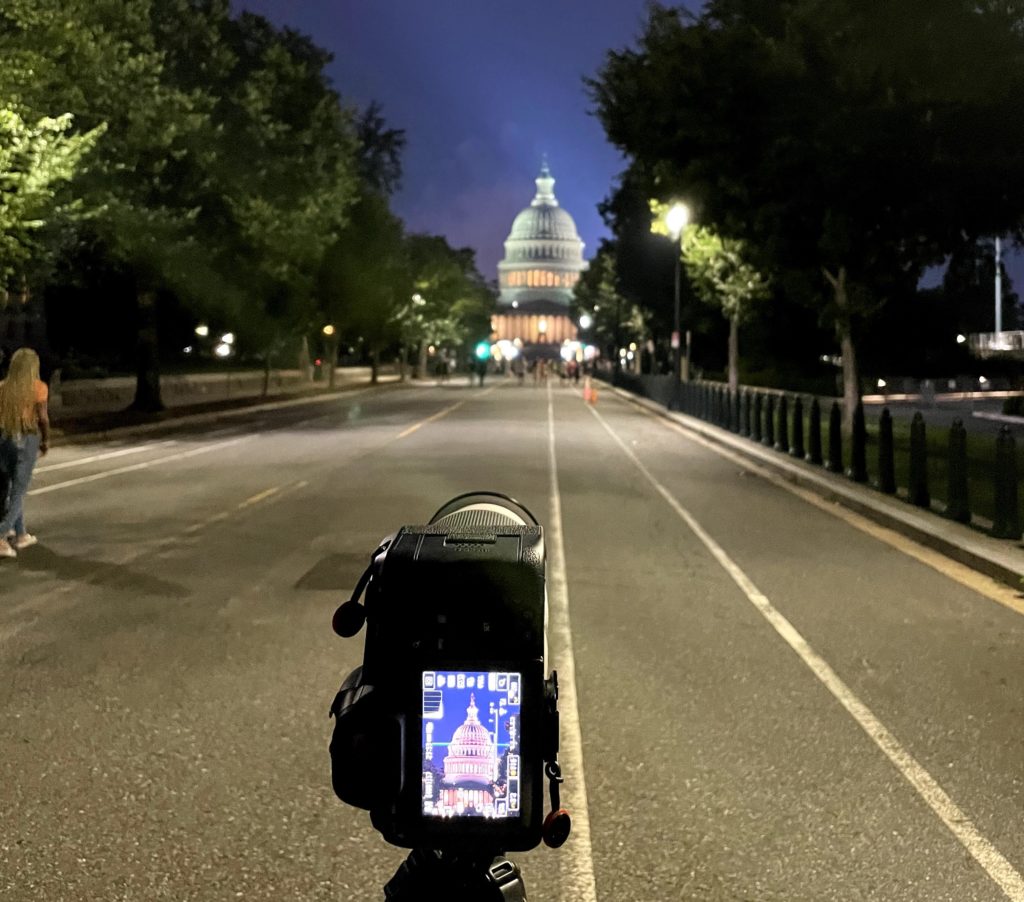
Things like the wind direction will affect where fireworks launch and if smoke will clear. Ideally you want some light wind to clear out the smoke from the fireworks to keep your shots clean.
This will help you have an angle in mind and being prepared for the show. Knowing where the fireworks will go off also helps you achieve interesting angles and lining up foreground or background elements.
4. Mind Your Focal Length and Composition
Focal length and composition are where fireworks shots go from snapshot to keeper. As a rough guide: a wide lens (14-24mm) is great when you want a big foreground or the whole crowd-and-sky scene, a standard zoom (24-70mm) is the do-everything option, and a telephoto (70-200mm) lets you compress a distant show against a skyline or landmark.
Whatever lens you use, leave room in the frame for the bursts to expand, since they climb higher than you expect, and shoot vertically for tall shells. The strongest fireworks photos almost always have something grounding them: a skyline, a monument, a bridge, or a crowd in the foreground. If there’s water nearby, shoot across it, since the reflection doubles the color and instantly makes the shot more dramatic.
One heads-up: on some zoom lenses the focus shifts when you change focal length, so reset your focus if you zoom. Swapping lenses or fiddling with settings mid-show also eats up valuable time during the best bursts, so try to lock in your composition early.
5. Show Up Early
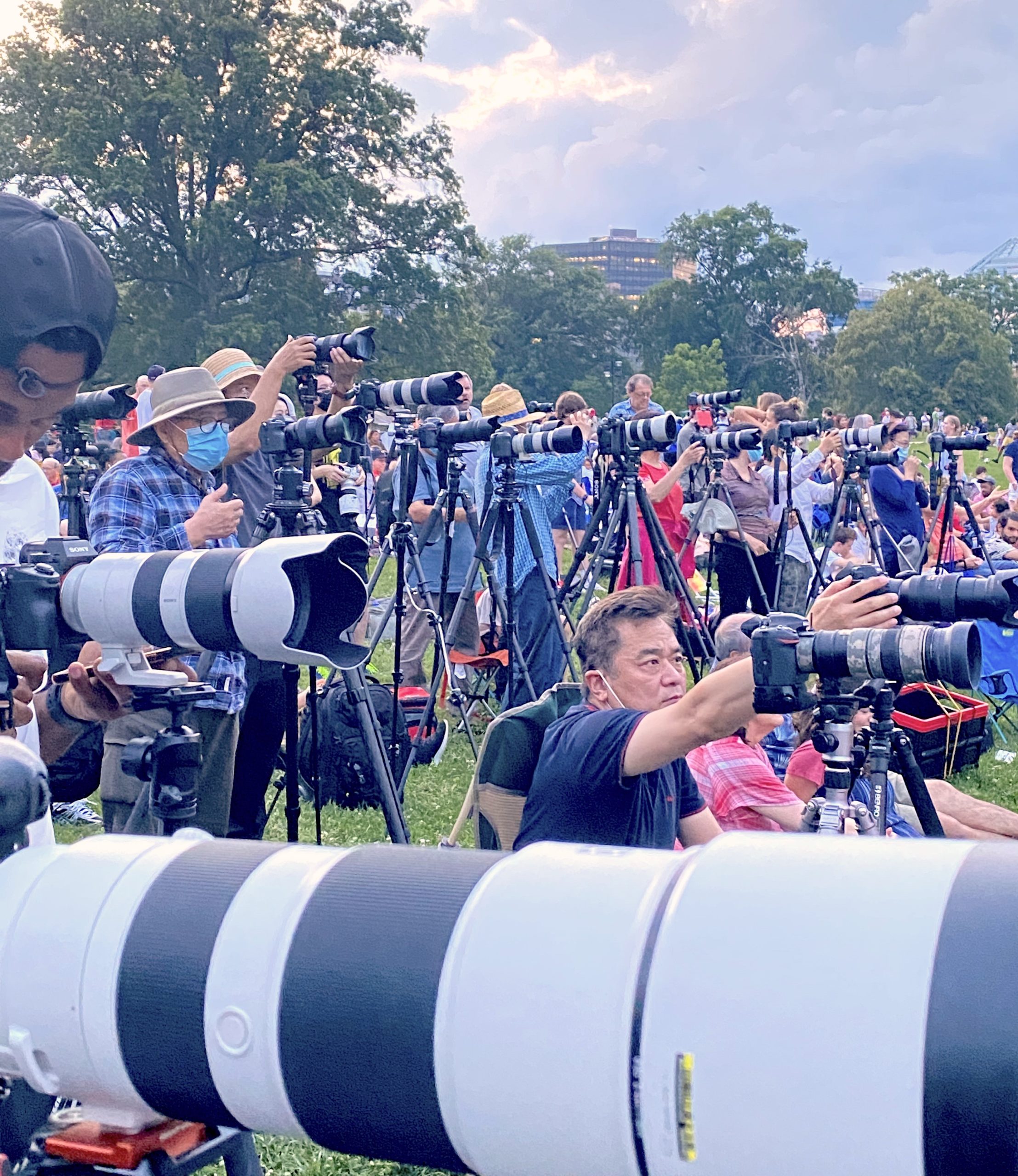
Some of the best vantage points for fireworks, especially in large cities will fill up with crowds hours in advance. It’s best to show up early so you can have room for your tripod and work out the best angle for your photos.
In Washington DC some of the best areas will be full of photographers hours before the show.
6. Shoot the Finale Carefully
The grand finale fires off many shells at once, so it’s far brighter than a single burst and easily blows out to a white blob. When the finale starts, shorten your exposure to a second or two, or stop down to a higher f-stop like f/16, so you keep the color and detail in all that light.
How to Photograph Fireworks on an iPhone
You don’t need a big camera to get a good fireworks shot. You just work a little differently on a phone. These tips are written for the iPhone, but most apply to other phones too:
- Steady the phone on a small tripod or brace it against something solid, then trigger the shutter with the volume button, a Bluetooth remote, or the timer so you don’t shake it.
- Tap and hold on a bright part of the sky to lock focus and exposure, then drag the exposure slider down so the bursts don’t blow out to white.
- Shoot Live Photos, then open one in the Photos app, swipe up, and apply the Long Exposure effect to turn a single burst into a streaking light trail.
- Skip the flash and avoid digital zoom, which just crops and softens the image.
- For true long exposures, use a manual camera app like Halide or Slow Shutter Cam, which let you hold the shutter open the way a DSLR does on a tripod.
How to Stack Multiple Fireworks Into One Photo
Some of the most dramatic fireworks images are actually several bursts combined into a single frame. There are two ways to do it:
The black card trick (in-camera). Put your camera in bulb mode and open the shutter, then hold a piece of black card (or a hat) just in front of the lens to “pause” the exposure between bursts without closing the shutter. Pull it away when a shell goes off, cover the lens again afterward, and repeat. After a few bursts, close the shutter. This stacks them into one photo while keeping the sky from overexposing.
Blending in Photoshop (easier). Shoot a series of normal single-burst frames from a locked-down tripod, then load your favorites as layers in Photoshop and set the upper layers to the Lighten blend mode. Lighten only keeps the bright pixels (the fireworks), so the bursts stack over the same dark sky. It’s far more forgiving than the black card and lets you cherry-pick the best bursts after the show.
Both methods rely on long-exposure technique, so if you want to go deeper it’s worth brushing up on night photography.
Firework Photography FAQ
Frequently asked questions about firework photography.
What camera do I need for firework photography?
You don’t need a specific camera for firework photography, but I recommended using a DSLR or mirrorless camera with a manual mode to adjust shutter speed, aperture, and ISO. My favorite camera brands include Canon, Sony, and Nikon.
What settings should I use for firework photography?
We’ve covered the in-depth settings for firework photography in this post, but here is a quick break down. Use a slow shutter speed of 3-5 seconds, a low aperture between f/8 and f/13, and a low ISO between 100 and 400. However, these settings may vary depending on the lighting conditions and the desired effect.
Do I need a tripod for firework photography?
Yes, a tripod is essential for firework photography as it helps to keep your camera steady during long exposures. I recommend using a sturdy tripod and a remote cable release (optional) to avoid camera shake.
Where is the best place to shoot fireworks?
The best place to shoot fireworks is from a high vantage point, such as a rooftop or a hill, where you can capture the fireworks against the skyline. You’ll want to arrive early to secure a good spot to avoid crowds.
How do I focus on fireworks?
To focus on fireworks, switch your camera to manual focus mode and set the focus to infinity. This ensures that your camera focuses on the distant fireworks rather than the surrounding environment. I typically focus on something near where I know the fireworks are being launched. Keep in mind that your focus may shift if you zoom your lens in or out.
Can I shoot fireworks with my smartphone?
Yes, you can shoot fireworks with a smartphone like an iPhone, but the results may not be as good as with a DSLR or mirrorless camera. It’s recommended to use a tripod and a third-party camera app with manual controls to adjust exposure settings.
How do I capture multiple fireworks in one shot?
Two ways: hold a long bulb exposure and use the black card trick to stack a few bursts in-camera, or shoot several single-burst frames from a tripod and blend them in Photoshop with the Lighten blend mode. See the section above on stacking multiple fireworks for the step-by-step.
How do I edit my firework photos?
To edit your firework photos, you’ll want to shoot in RAW and use a photo editing software such as Adobe Lightroom or Photoshop. Adjust the exposure, contrast, and color temperature to enhance the fireworks and remove any unwanted noise or distractions from your shots. It’s a lot of fun to edit the light trails you’ve captured from the fireworks.
What should I avoid when shooting fireworks?
When shooting fireworks, avoid using a flash as it can wash out the fireworks and ruin the exposure. Also, avoid using autofocus as it may focus on the wrong subject and miss the fireworks.
I hope this guide helps you capture the show. If you have any questions or tips of your own, let me know in the comments below.
Want to improve your travel photography?
Read: Travel Photography Tips
No matter if it’s New Year’s Eve or the 4th of July I wish you luck capturing the fireworks display.
Read this article once. Tried the tips/recommendations, and got a shot can’t stop looking at. Thank you!
Glad it helped Brad!